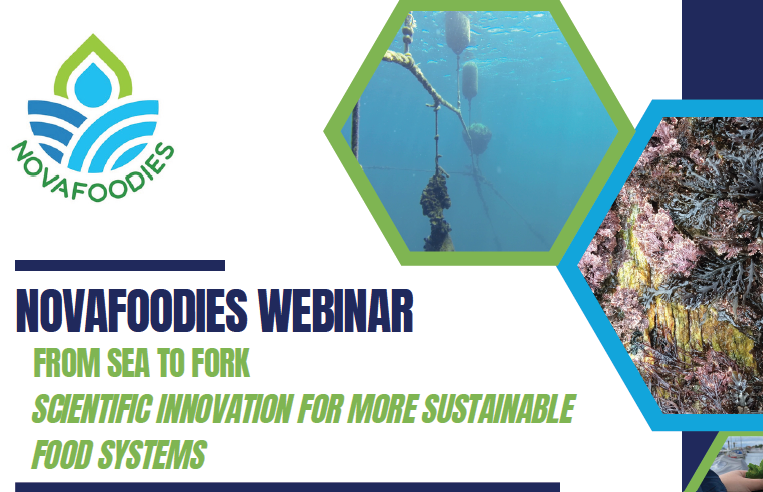
FROM SEA TO FORK – Scientific Innovation for More Sustainable Food Systems
Driving innovation in aquatic food systems for sustainability, nutrition and inclusion
On 30 April 2026, the NOVAFOODIES partners SPES/Federalimentare and LVA successfully hosted the online webinar “From Sea to Fork: Scientific Innovation for More Sustainable Food Systems”, bringing together experts from research, industry and policy to explore cutting-edge developments in the seafood and aquaculture sectors. Held via Zoom from 10:00 to 12:30 (CEST), the event highlighted the role of innovation in advancing sustainability, resilience and inclusiveness along the aquatic food value chain.
The webinar provided a platform to showcase how scientific research and technological innovation are transforming marine food systems, aligning with European priorities on sustainability, nutrition and food security. Participants gained valuable insights into novel and functional foods, as well as emerging approaches aimed at improving environmental performance and diversifying protein sources.
Opening the session, Michael Brugger (LVA) presented an overview of the NOVAFOODIES project, outlining project’s key objectives and ongoing activities. His intervention set the stage by emphasising the project’s mission to promote innovative, sustainable, and consumer-oriented solutions in the food sector.
A central theme of the webinar was the exploration of alternative and sustainable protein sources. Andrea Visca (ENEA) and Amina Antonacci (CNR) delivered a joint presentation on algae-based innovation for protein diversification. Their contribution addressed key aspects such as sensory quality, nutritional value and applied research perspectives, underlining algae’s potential as a viable and scalable solution for future food systems.
The discussion continued with Neil Duncan (IRTA), who introduced the BLUEBOOST initiative. His presentation focused on the co-cultivation of species as an innovative approach to enhance both economic efficiency and environmental sustainability in aquaculture. By integrating species in balanced systems, co-cultivation can optimise resource use and reduce ecological impact, offering promising pathways for the sector.
The webinar also addressed the social dimension of sustainability. Carlos Alonso Leal (Acción Contra el Hambre) presented on empowering EU aquaculture stakeholders for inclusion and gender equality. His intervention highlighted the importance of fostering equitable participation across the sector, ensuring that innovation goes hand in hand with social responsibility and inclusiveness.
Moderated by Giorgia Sabbatini (SPES/Federalimentare), the session encouraged dynamic exchanges between speakers and participants, fostering a collaborative dialogue on the future of aquatic food systems. The diversity of perspectives—spanning science, industry, and social innovation— reaffirmed the importance of interdisciplinary collaboration in driving the transition towards more sustainable and more circular value chains.
To further support knowledge sharing and dissemination, the speakers’ presentations are attached to this article. These materials provide a valuable resource for stakeholders interested in exploring the topics discussed in greater depth, and for those who were unable to attend the live session.